- Home
- Kombucha FAQ
Kombucha FAQ
Straight answers on what kombucha is, what it does, alcohol, sugar, storage and brewing your own.
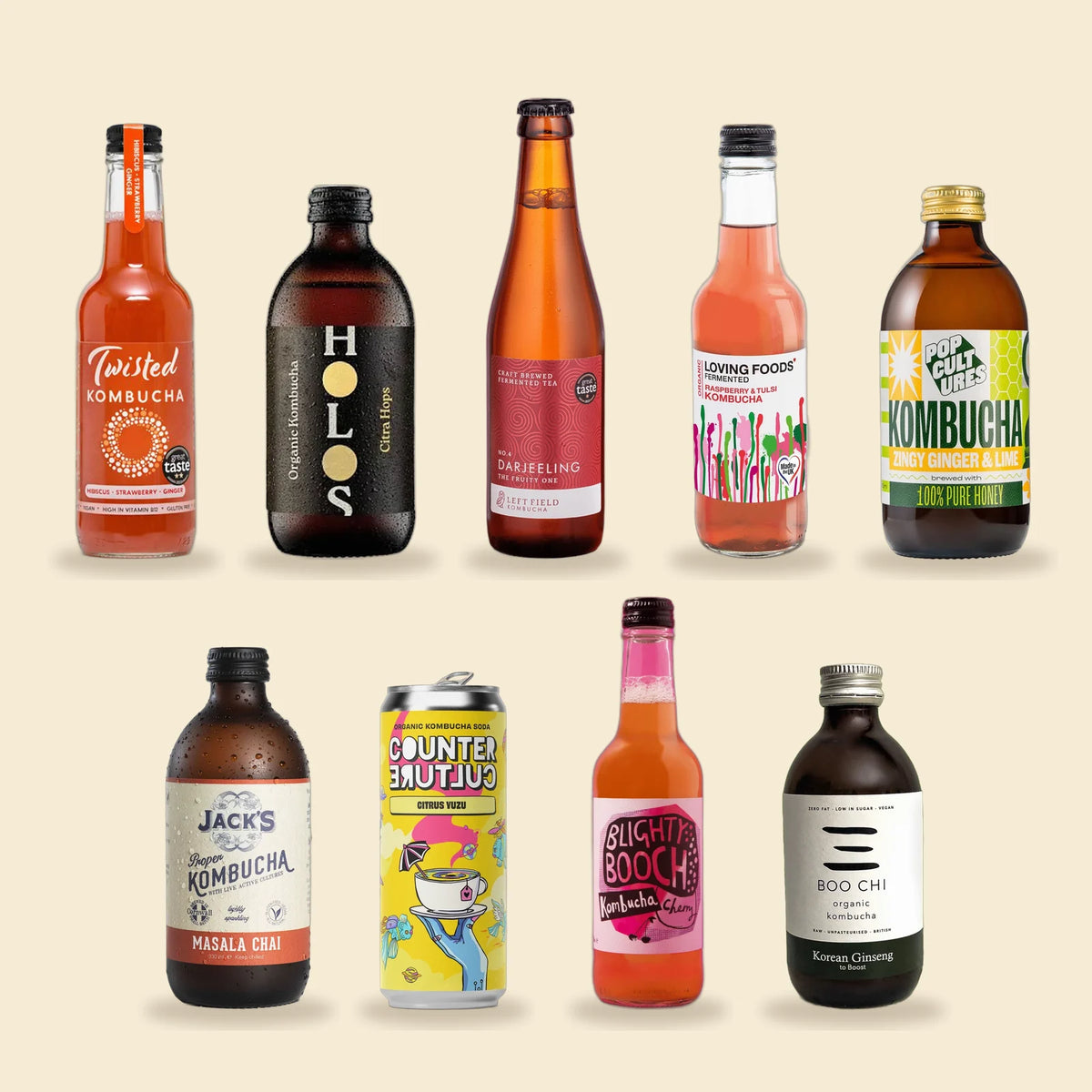
Welcome to the UK's most comprehensive kombucha FAQ. Whether you're new to kombucha or a seasoned enthusiast, this guide answers everything you need to know about this ancient fermented tea drink. We stock the largest range of kombucha in the UK, and we're here to help you find the perfect brew.
Understanding Kombucha
What is kombucha and where does it come from?
Kombucha is a fermented tea beverage with origins dating back over 2,000 years to Northeast China. It's made by fermenting sweetened tea (black, green, or oolong) with a SCOBY, a symbiotic culture of bacteria and yeast.
During fermentation, the SCOBY consumes the sugar and produces organic acids, live cultures and natural carbonation. The result is a tangy, slightly sweet, effervescent drink that's become increasingly popular in the UK for its unique flavour.
Traditional kombucha has been consumed across Asia and Eastern Europe for centuries, and modern craft brewers have elevated it with creative flavours using fruits, herbs, and botanicals.
What does SCOBY stand for and what does it do?
SCOBY stands for Symbiotic Culture of Bacteria and Yeast. It's a living, rubbery disc (sometimes called a "mother" or "pellicle") that floats on top of fermenting kombucha.
The SCOBY contains bacteria (like Acetobacter) and yeast strains that work together to transform sweet tea into kombucha. As it ferments, the SCOBY produces organic acids (acetic, gluconic, lactic) and more live cultures while consuming the sugar. Each batch grows a new layer of SCOBY, which can be used to start new batches or shared with other home brewers.
If you're interested in brewing your own, check out our kombucha starter kits which include a healthy SCOBY and everything you need to get started.
How is kombucha different from other fermented drinks?
While kombucha shares the fermentation process with other fermented drinks, it's uniquely tea-based and SCOBY-fermented. Unlike water kefir (fermented with kefir grains in sugar water) or milk kefir (fermented dairy), kombucha keeps the character and polyphenols of the tea it's brewed from.
It differs from kvass (a Slavic fermented bread drink) in both base ingredients and flavour profile. Jun, sometimes called "champagne of kombucha," uses green tea and honey instead of black tea and sugar.
Kombucha's distinctive tangy-sweet taste, natural fizz, and tea character make it stand out in the fermented beverage category. We stock a wide variety of styles in our kombucha collection.
What the Research Says
What does the research say about kombucha and gut health?
Raw kombucha is a fermented food, with live cultures and organic acids from fermentation. Research into fermented foods is moving fast. In a 2021 Stanford study, adults who ate six servings a day of fermented foods, including kombucha, had more diverse gut bacteria after 10 weeks (Wastyk et al., Cell, 2021).
Research on kombucha on its own is still early, with few human trials so far. We'd rather be straight with you than overclaim: kombucha is a food, not a treatment, and it works best as part of a varied diet with plenty of fibre and plants.
Want the longer version? Our guide to bloating, wind and an unsettled gut walks through what the research actually shows.
How much kombucha should I drink?
Start with 100 to 150ml (about half a bottle) a day, and build up to a full 330ml bottle if you enjoy it.
Some enthusiasts drink up to 500ml daily, but there's no evidence that more is better. Listen to your body: if you experience any stomach discomfort, cut back. The key is consistency rather than quantity. A small glass every day beats an occasional big bottle.
If you're new to fermented foods, start slowly. Building your own box of 6, 12 or 24 makes it easy to keep a regular supply in the fridge and build the habit.
Can kombucha help with health conditions?
Kombucha is a food, not a treatment, and it isn't a cure for any medical condition.
If you have a medical condition, especially an autoimmune disorder, diabetes, or a weakened immune system, check with your GP or healthcare provider before adding kombucha to your routine.
Pregnant and breastfeeding individuals should also seek medical advice due to the trace alcohol, caffeine, and live cultures. Kombucha works best as part of an overall healthy lifestyle, not as a standalone treatment.
Alcohol, Safety & Who Can Drink It
Does kombucha contain alcohol and how much?
Yes, all kombucha naturally contains trace amounts of alcohol as a byproduct of fermentation. Commercial kombucha in the UK typically contains 0.5% ABV or less, classifying it as non-alcoholic (the legal threshold is 0.5% ABV).
Home-brewed kombucha can sometimes reach 1-2% ABV if fermented longer or in warmer conditions. The alcohol content varies by brand, fermentation time, and storage conditions. Kombucha left unrefrigerated continues fermenting and can develop higher alcohol levels.
If you're avoiding alcohol entirely for religious, health, or recovery reasons, be aware of this trace content. All our commercial kombuchas are clearly labelled with their alcohol content, and most are well below 0.5% ABV.
Is kombucha safe during pregnancy and breastfeeding?
This is a personal decision best made with your healthcare provider. Concerns include the trace alcohol content (typically under 0.5% ABV), caffeine from tea (15-30mg per bottle, less than coffee), live bacteria cultures, and the unpasteurised nature of most craft kombucha.
Some midwives and doctors approve moderate consumption of commercial, refrigerated kombucha, while others recommend avoiding it entirely during pregnancy and breastfeeding.
If you're already a regular kombucha drinker and your healthcare provider approves, continuing with small amounts of trusted brands may be fine. However, pregnancy is not the time to introduce new fermented foods. If you're unsure, opt for pasteurised kombucha or wait until after breastfeeding.
Can children drink kombucha?
Kombucha is generally not recommended for young children due to the trace alcohol, caffeine, acidity, and live cultures. Most experts suggest waiting until at least age 4, and even then, limiting intake to very small amounts (50-100ml) of mild-flavoured varieties.
Teenagers can typically handle kombucha better, but it's wise to start with low doses. The acidity can also affect developing tooth enamel, so encourage children to rinse their mouth with water after drinking.
Some parents dilute kombucha with water or choose lower-caffeine varieties. Always consult your child's paediatrician before introducing fermented beverages, especially if they have any health conditions or sensitivities.
Are there any side effects or risks from drinking kombucha?
Most people tolerate kombucha well, but some experience temporary digestive changes when first introducing it, including bloating, gas, or changes in bowel movements as their body gets used to it.
Drinking too much too quickly can cause these effects. Very rarely, people with histamine sensitivity may react to fermented foods. Contaminated home-brewed kombucha (from improper hygiene or mould) can cause serious illness, which is why we recommend starting with commercial brands.
The acidity can affect tooth enamel over time, so don't sip it constantly throughout the day. People with weakened immune systems should consult doctors before consuming unpasteurised fermented products. If you experience persistent negative symptoms, stop drinking it and consult a healthcare provider.
Types, Flavours & Quality
What's the difference between raw and pasteurised kombucha?
Raw (unpasteurised) kombucha keeps its live cultures because it hasn't been heat-treated. This is the traditional form. However, it must be kept refrigerated and has a shorter shelf life.
Pasteurised kombucha has been heated to kill bacteria, extending shelf life and allowing room-temperature storage. The trade-off is that pasteurisation kills the live cultures. You still get the flavour and organic acids, but nothing in the bottle is alive any more.
At Functional Drinks Club, we specialise in raw, unpasteurised kombucha from premium UK and European producers because we believe in the real thing.
Why does kombucha taste sour or vinegary?
Kombucha's characteristic tang comes from organic acids, primarily acetic acid (the same acid in vinegar), gluconic acid, and lactic acid produced during fermentation.
The longer kombucha ferments, the more sugar is consumed and the more acidic it becomes. A well-balanced kombucha should be pleasantly tangy with a hint of sweetness, not overwhelmingly sour.
If your kombucha tastes extremely vinegary, it may have over-fermented (common in home brewing or if left unrefrigerated). Flavoured kombuchas balance the natural sourness with fruit, botanicals, herbs, or floral notes.
If you're new to kombucha, try fruit-forward flavours like elderflower, ginger, or berry varieties which offer a gentler introduction to the taste.
What's the best kombucha for beginners?
Start with lightly flavoured, fruit-forward varieties that balance kombucha's natural tang with familiar, approachable tastes. Ginger kombucha is excellent for beginners, the ginger adds warmth and complements the fermented flavour.
Elderflower and berry varieties offer floral sweetness that makes the sourness more palatable. Avoid very sour or heavily hopped varieties until you've developed a taste for the base flavour.
We recommend building a mixed box to discover your preferences without committing to a full case of one flavour. Brands like Blighty Booch offer beginner-friendly options. Once you're comfortable, explore more adventurous flavours like nettle & rosehip or hopped varieties.
Why is there sediment or floaties in my kombucha?
Sediment, strands, or "floaties" are completely normal and actually a sign of quality in raw, unpasteurised kombucha. These are yeast particles and bacterial cultures, the live cultures that make raw kombucha raw.
Some bottles have more sediment than others depending on the brewing process and how long it's been since bottling. You can either tip the bottle gently to distribute the sediment throughout (this gives you all the live cultures) or pour carefully and leave it at the bottom. Both approaches are safe.
If you see a small SCOBY forming in the bottle, that's also normal in raw kombucha. The only thing to avoid is mould (fuzzy, coloured growth), which shouldn't occur in properly produced commercial kombucha.
Storage, Shelf Life & Serving
Does kombucha need to be refrigerated and why?
Yes, raw kombucha must be refrigerated at 2-4°C to slow down fermentation and maintain quality. Unlike pasteurised drinks, raw kombucha contains live cultures that continue fermenting at room temperature.
Unrefrigerated kombucha will become increasingly sour, develop higher carbonation (potentially causing bottles to explode), and may increase in alcohol content.
Refrigeration preserves the intended flavour balance, carbonation level, and the live cultures. If you've purchased kombucha from our shop or received a delivery, transfer it to your fridge immediately.
For events or picnics, keep kombucha in a cooler with ice packs. Pasteurised kombucha (less common in our range) can be stored at room temperature until opened, but we focus on raw varieties.
How long does kombucha last and what's the shelf life?
Unopened, refrigerated kombucha typically lasts 6-9 months from the bottling date, though it's best consumed within 3-4 months for optimal flavour.
Check the best-before date on each bottle. Once opened, consume within 3-5 days for the best taste and carbonation, after that, it's still safe but may lose fizz and become more sour.
Kombucha doesn't "go bad" in the traditional sense because the acidic environment prevents harmful bacteria, but the flavour will continue to develop (become more vinegary) over time. If you notice mould, off-putting smells, or unusual colours, discard it.
Should I shake kombucha before drinking?
Gently tip it rather than shake it. Tipping distributes the yeast sediment throughout the drink, giving you the live cultures in every sip. Shaking releases carbonation, making it fizzier when you open it (be careful of overflow).
If you prefer maximum fizz and don't mind sediment settling, pour gently without moving it. If you want all the live cultures and don't mind slightly less carbonation, give it a gentle tip or swirl. Some people tip, then wait 30 seconds before opening to let bubbles settle slightly. There's no wrong way, experiment to find your preference.
Brewing Your Own Kombucha
How do I start brewing kombucha at home?
Home brewing is rewarding and cost-effective once you're set up. You'll need: a SCOBY with starter liquid, tea (black, green, or oolong), sugar, a large glass jar, breathable cloth cover, and bottles for second fermentation.
Our kombucha starter kits include everything except the jar and bottles. The basic process: brew sweet tea, cool it completely, add SCOBY and starter liquid, cover with cloth, and ferment for 7-14 days at room temperature (18-24°C).
Taste daily after day 7 until it reaches your preferred balance of sweet and sour. For fizzy kombucha, bottle it with a bit of fruit or juice for second fermentation (2-5 days).
The learning curve is gentle, and once established, your SCOBY will produce batch after batch. Ask us in-store about our next tasting session where we cover brewing basics.
What's the difference between first and second fermentation?
First fermentation (F1) is when the SCOBY ferments sweet tea in an open vessel (covered with cloth) for 7-14 days, transforming it into basic kombucha.
This produces a still or lightly fizzy drink with the characteristic sour-sweet flavour. Second fermentation (F2) is optional, you bottle the finished kombucha with added flavourings (fruit, juice, herbs, ginger) and seal it for 2-5 days at room temperature.
The remaining yeast consumes the added sugars, producing carbonation and developing more complex flavours. F2 creates the fizzy, flavoured kombucha you find in shops.
You can skip F2 and drink kombucha straight from F1, but it will be less carbonated and unflavoured. F2 requires careful monitoring to avoid over-carbonation and bottle explosions.
How do I know if my home-brewed kombucha has gone wrong?
Mould is the main concern. It appears as fuzzy, dry, coloured spots (green, black, white, or grey) on top of the SCOBY or liquid surface, similar to bread mould.
If you see mould, discard everything (SCOBY and liquid) and start fresh with a new SCOBY. Don't try to save it. Normal SCOBY variations include brown yeast strands, uneven texture, holes, or thin/thick layers, these are fine.
Your kombucha should smell pleasantly sour and vinegary; if it smells rotten, cheesy, or putrid, something's wrong. Fruit flies or insects in your brew mean it's contaminated, so always use a tight-weave cloth cover.
Over-fermentation makes kombucha very sour but isn't dangerous; you can use it as starter liquid or vinegar. When in doubt, trust your senses and start fresh with a healthy SCOBY from our starter kits.
Shopping & Delivery
What brands of kombucha do you stock?
We pride ourselves on offering the largest kombucha selection in the UK, featuring premium raw and organic brands. Our range includes Blighty Booch (British-made with creative flavours), Left Field Kombucha (sophisticated, tea-led kombuchas), and many others.
We carefully curate brands that prioritise quality ingredients, traditional fermentation methods, and genuine craft. All our kombuchas are raw and unpasteurised, so the live cultures are still in there.
We regularly rotate seasonal and limited-edition flavours, and we're always adding new producers. Visit our Otley shop, just 20 minutes from Leeds, to taste before you buy, or explore our full range online.
Do you deliver kombucha across the UK?
Yes, we offer nationwide UK delivery for all our kombucha products. Order individual bottles, mixed cases, or full cases of your favourite flavours. Standard UK delivery is £5.99 per order.
Local customers can choose free collection from our Otley taproom, just 20 minutes from Leeds.
Orders are packed within 3 working days, then sent tracked overnight with Royal Mail. For the best value, build a box: mix any 6, 12 or 24 for up to 15% off.
What's the best way to try different kombucha flavours?
We recommend building your own mixed box, which lets you sample multiple brands and flavours without committing to full cases. Many brands offer their own mixed packs, for example, the Blighty Booch Mixed Case.
If you're local to Otley or Leeds, visit our taproom for individual bottles and in-person recommendations. We also run kombucha tasting sessions where you can try 6-8 varieties and learn about flavour profiles, brewing methods, and the research.
Dietary Considerations
Is kombucha vegan and suitable for plant-based diets?
Yes, virtually all kombucha is vegan as it's made from tea, sugar, water, and bacterial/yeast cultures with no animal products.
The SCOBY itself is a colony of bacteria and yeast, not an animal. Some kombuchas use honey instead of sugar (called "jun"), which some vegans avoid, so check labels if this matters to you.
Kombucha is also a handy fermented food for vegans who don't eat dairy kefir or yoghurt.
Is kombucha gluten-free and safe for coeliacs?
Pure kombucha made from tea, sugar, and cultures is naturally gluten-free. However, always check labels because some flavoured varieties might include gluten-containing ingredients, and cross-contamination can occur in facilities that process multiple products.
The vast majority of commercial kombuchas are gluten-free. If you have coeliac disease or severe gluten sensitivity, look for products with gluten-free certification or contact the manufacturer to confirm their production processes.
Can I drink kombucha if I'm diabetic or watching sugar intake?
Kombucha contains residual sugar that wasn't consumed during fermentation, typically 2-6g per 100ml, depending on the brand and fermentation length.
This is significantly less than full-sugar soft drinks (10-12g per 100ml) but still worth considering. If you have diabetes, start with small amounts, choose varieties with lower sugar content (check nutrition labels), and speak to your healthcare provider or dietitian for personalised advice.
Still have questions? Visit our Otley taproom, just 20 minutes from Leeds, to speak with our team, or join one of our kombucha tasting sessions. Browse the UK's largest kombucha range online with nationwide delivery.